• Banner_cafe1
  • Banner_Cafe2
  • Banner_Cafe3
  • slider jquery
  • Banner_Cafe5
Banner_cafe11 Banner_Cafe22 Banner_Cafe33 Banner_Cafe44 Banner_Cafe55
bootstrap carousel by WOWSlider.com v8.8

COFFEE

The International Coffee Organization (OIC) differentiates four basic qualities: unwashed Arabic, soft Colombian; others soft or central and robust. The distribution of the market is relatively proportional between these groups. The largest share corresponds to unwashed Arabs, which contribute 28% of world exports. Central and robust coffees each represent 26% of the market and soft Colombians 19%. Although a large number of countries contribute to supply, the eight main producers account for 68% of world exports. The concentration is higher in the various groupings. Thus, Brazil and Colombia account for 92% and 79% of the world production of unwashed and soft Colombian Arabs, respectively, thus exercising a virtual monopoly of such qualities and a great control over the global market.

The concentration is somewhat lower in the case of the robust ones, where the three main producers (Côte d’Ivoire, Indonesia and Uganda) concentrate in any case 65% of world sales. Finally, the most competitive market is central coffee, where the three major producers (El Salvador, Mexico and Guatemala) represent 48% of the supply in the world market, but there is a broad set of products in Central America, the Caribbean and Asia.

Coffee varieties by geographical area

GLOBAL COFFEE PRODUCTION

Global coffee production is at historic levels, driven by major producing countries and international demand.

Key production figures
  • Total volume: Global production reaches approximately 183.6 million to 190 million bags (60 kg each), equivalent to more than 11.3 million tonnes annually.
  • Coffee types: Arabica coffee accounts for approximately 57%–60% of global production, while Robusta (Canephora) makes up the remaining 40%–43%.
  • Major producing countries:
  1. Brazil: The undisputed leader, accounting for nearly 35% of the global supply (averaging 63 million bags, or over 3.1 million tonnes).
  2. Vietnam: The second-largest global producer and the primary source for Robusta coffee.
  3. Colombia: The third-largest global producer, known primarily for its high-quality washed Arabica coffee.
  4. Other notable producers: Indonesia, Ethiopia, Uganda, Honduras, and India.
Regional distribution
  • Latin America: Produces nearly 85% of the world’s Arabica.
  • Asia: Contributes about 10%, led by Vietnam and Indonesia.
  • ​​Africa: Accounts for the remaining 5%, with countries such as Ethiopia and Uganda at the forefront.

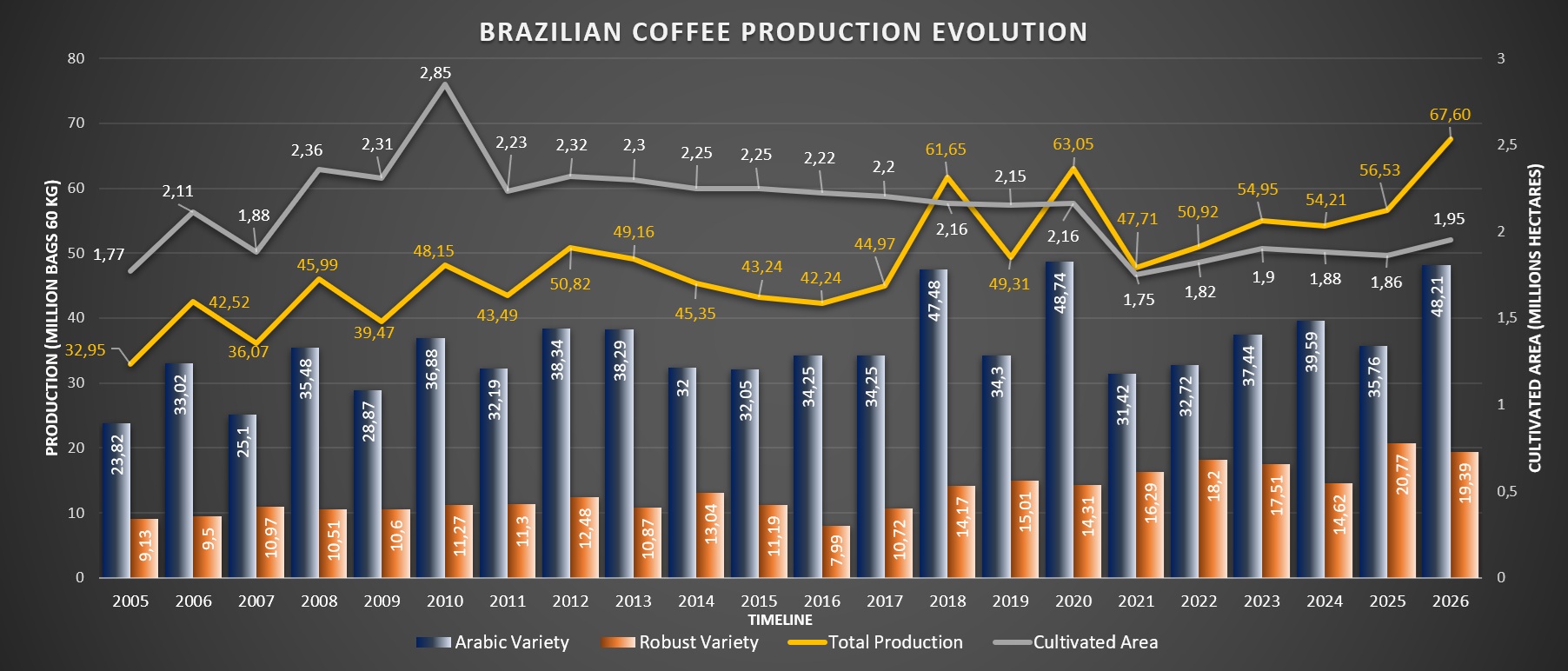
Brazilian Coffee

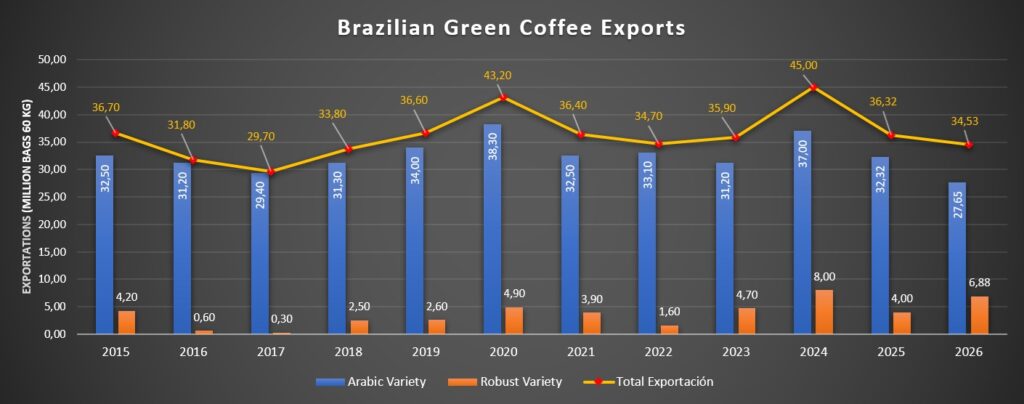
By 2026, Brazil has reached a historic milestone in its coffee sector, combining a record harvest with a recovery in export flows:

Coffee Production in Brazil (2026)
  • Estimated total harvest: The National Supply Company (CONAB) forecasts a record production of 67.6 million bags (60 kg each), representing an increase of nearly 20% compared to the previous year.
  • Arabica coffee: Accounts for approximately 70% of the total, with an estimated 48.2 million bags (a 34.8% increase over 2025).
  • Conilon/Robusta coffee: Projected at 19.4 million bags.
Coffee Exports (2026)
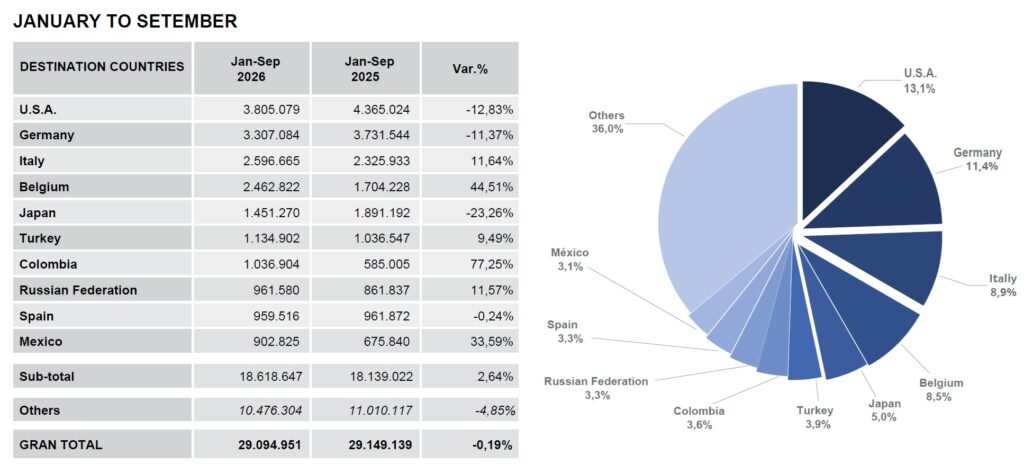
  • Cumulative volume: Between January and September 2026, Brazil exported approximately 29.1 million bags—a figure that remained virtually stable (-0.2%) compared to the same period in 2025—bolstered by the arrival of the new harvest following delays caused by rainfall in July.
  • Foreign exchange earnings: In the first nine months of the year, exports generated approximately $10.113 billion, reflecting an 8.6% decline in value compared to the previous year, driven by trends in international prices.
  • Key destinations:
  • The United States reclaimed the top spot as the largest buyer of Brazilian coffee (with 3.8 million bags in the first nine months of the year) following a resumption in its imports.

• Germany ranks second (3.3 million bags), followed by other major markets in Europe and Asia, including Belgium, Italy, and Japan.

BRAZILIAN COFFEE EXPORTS TO MAJOR DESTINATIONS

Period: January to September 
60 kg bags

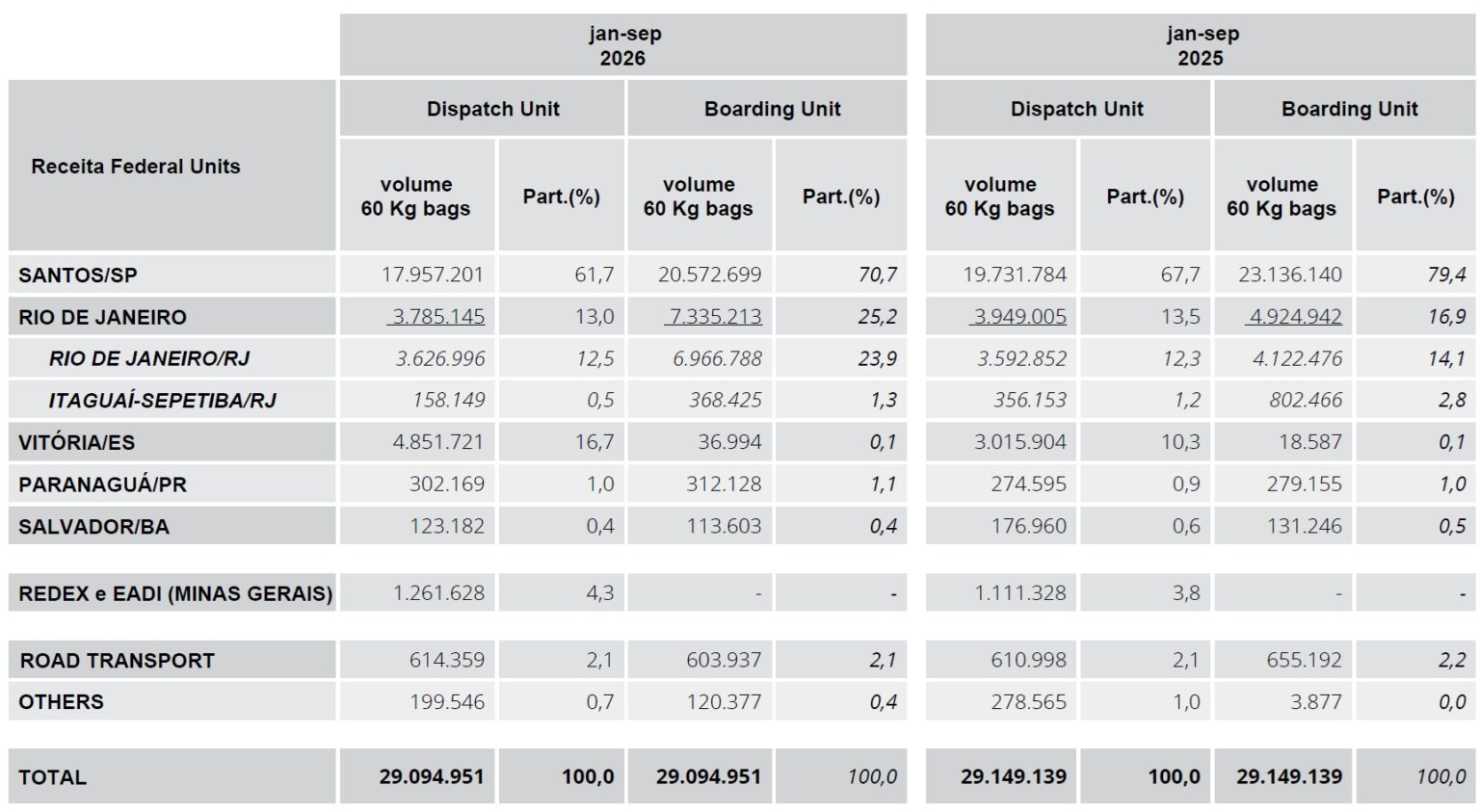
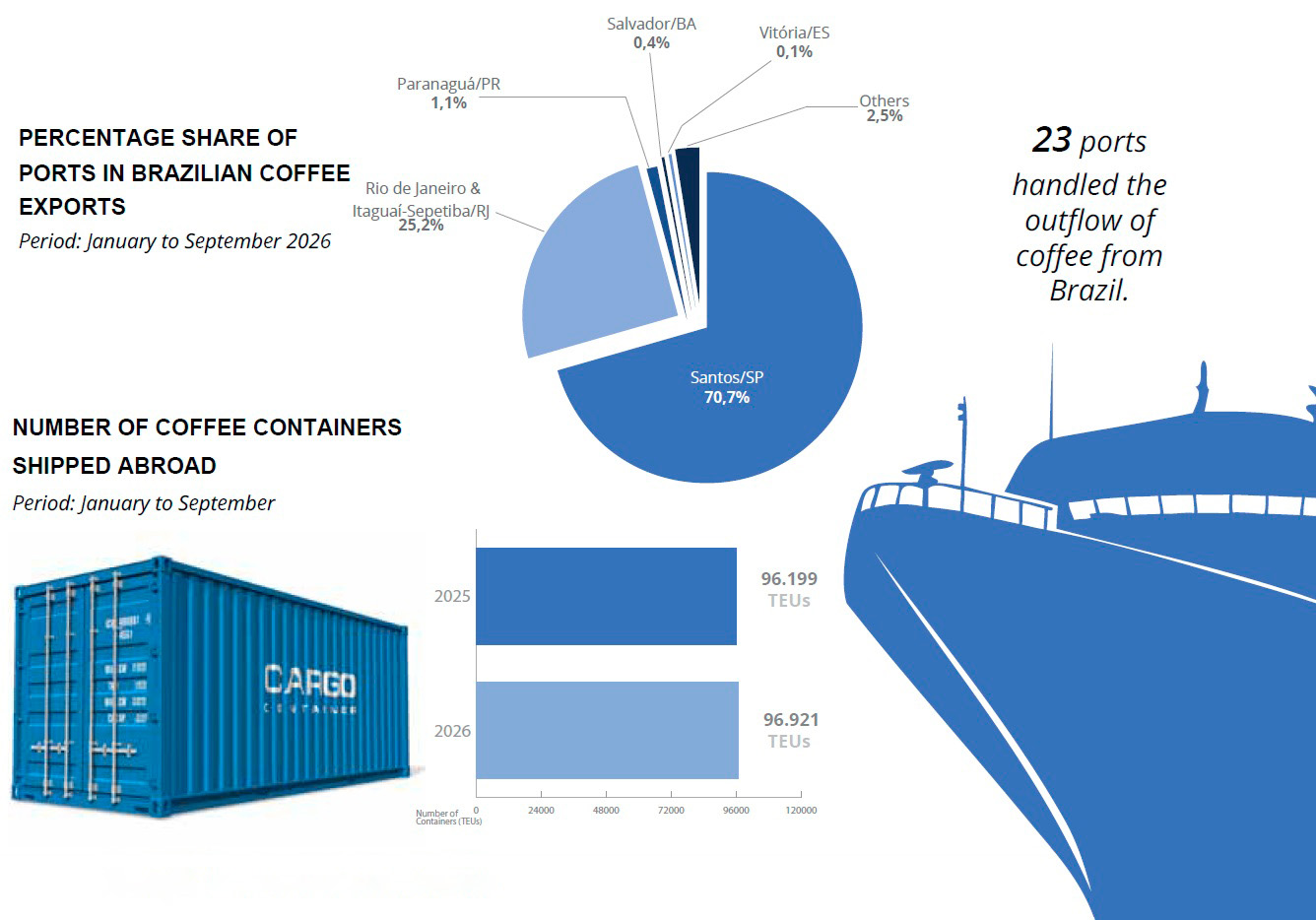
BRAZILIAN COFFEE EXPORTS BY DISPATCH AND SHIPMENT UNITS

Period: January to September
60 kg bags

Portos de saida-1
Availability:
Immediate
Product Origin:
Brazil / Colombia
Delivery term:
45 days
Buyer's Documents:
LOI & RWA
Incoterms:
FOB / CFR / CIF
Payment Terms:
30% Advanced TT. 70% Remaining, L/C against Shipping Documents
Avaikability:
Immediate
Incoterms:
FOB / CIF
Buyer's Doc.:
LOI / RWA
Delivery Term
45 days
Product Origin:
Brazil / Colombia
Payment Terms:
30% Advanced TT. 70% Remaining, L/C against Shipping Documents

We offer a complete range of commodities originating in South America.

Contacts
Subscribe

Follow our newsletter to stay updated about agency.

Copyright © 2022  Global Sky Business. All Rights Reserved.